Electric Two-Wheelers
Electric two-wheelers (E-2W), including e-bikes, e-scooters and e-motorcycles, are a rapidly growing segment of low-power electric vehicles (LPEV). They are widely adopted because they offer a low-cost, convenient, and environmentally friendly mobility solution for daily commuting, last-mile travel, and delivery services. Their quiet operation, easy maneuverability, and minimal maintenance make them ideal for dense urban environments. Consumers and businesses choose E-2Ws for their low operating cost, instant torque, and ease of charging or battery swapping, while governments promote them to reduce urban pollution and dependence on fossil fuels.
2. Key Functional Blocks and System Diagram of an Electric Two-Wheeler
Modern electric two-wheelers are powered by lithium-ion battery packs, with voltage typically ranges from 24 V to 96 V, and rely heavily on a critical supervisory unit — the Battery Management System (BMS). The BMS is an intelligent electronic control system that continuously monitors and manages the battery pack, serving as the interface between the battery and the vehicle. By collecting real-time data such as cell voltage, pack voltage, current, temperature, and state of charge (SOC), the BMS performs essential functions including charge and discharge control, cell balancing, fault detection, and protective actions such as disconnecting the battery during short-circuit, overcurrent, or abnormal temperature conditions.
For traction, most E-2Ws adopt BLDC motors due to their cost-effectiveness, simple construction, high efficiency, and reliability. These motors are driven by a MOSFET-based three-phase inverter, which converts the battery’s DC power into controlled AC waveforms for torque and speed regulation.
In addition to the traction system, an E-2W has other key components such as the headlamp, indicators/flasher, horn, dashboard, onboard charger, and convenience features such as USB charging ports and telematics modules. All these systems are designed with a focus on energy efficiency, operational safety, and low maintenance, ensuring a reliable and user-friendly riding experience.
The following represents a functional block diagram of a typical E-2W system:
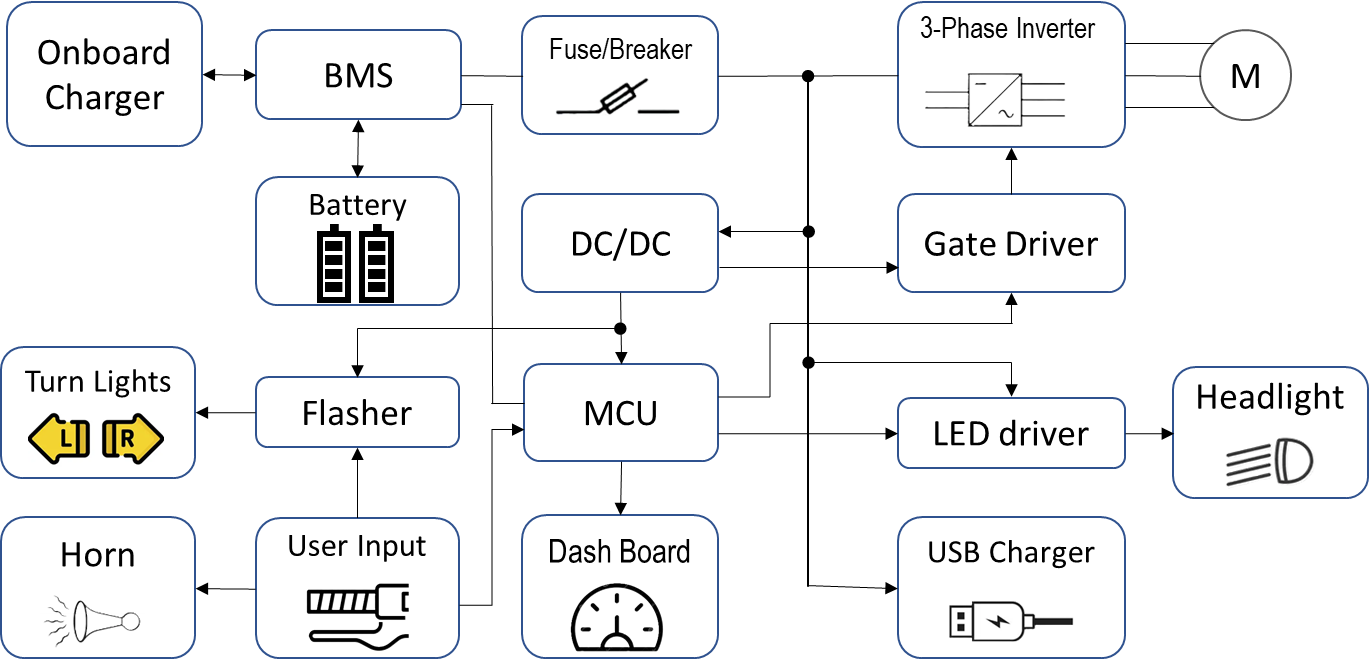
Fig 1. System Diagram of an Electric Two-Wheeler
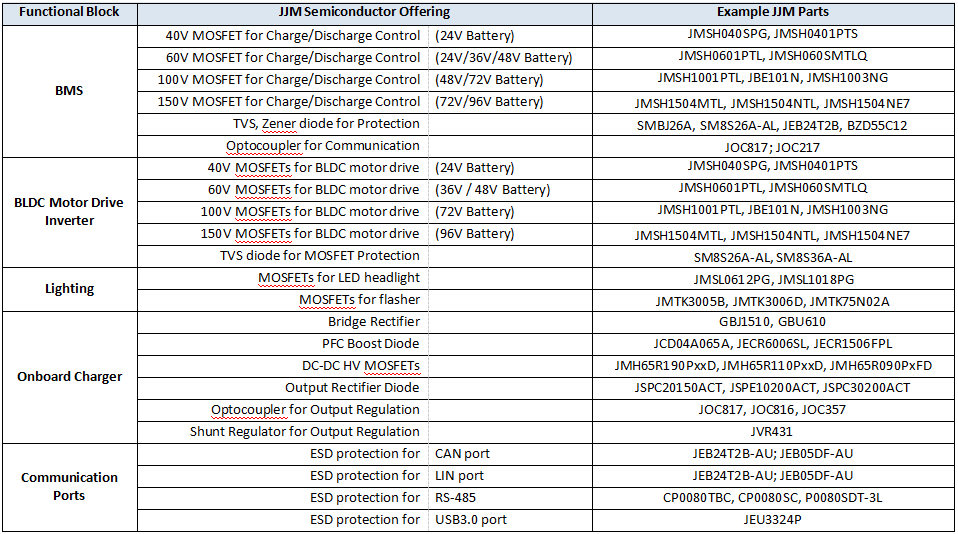
3. Recommended JJM Products for Key Functional Blocks
Recommended JJM semiconductor products for major functional blocks:
4. Summary
Electric two-wheelers require highly efficient and reliable semiconductor devices across BMS, motor drive, charging, lighting, and auxiliary subsystems. JJM offers complete MOSFET, diode, and protection component solutions that meet performance and safety requirements for the e-two-wheelers market.
For more product details, please visit JJM’s product webpage.